Custom packaging cost is the full price per unit for boxes built to your size and material along with print specs including setup and finishing or freight. In 2027, it runs from roughly $0.40 to more than $20 per box; depending on box type and material as well as print method and order volume.
In this guide, the starting point will be the range of cost and then we will look at the factors that determine cost. Then we will have a section on box type and order quantity, as well as print method and finishing along with hidden costs and cost changes in the year 2027.
How Much Does Custom Packaging Cost in 2027?
Most custom boxes cost between $0.40 and $5.00 per unit in 2027 while rigid boxes usually start near $2.50 and reach $20 or more per unit.
There is no set price due to four key considerations affecting price at any given time. Ranges run wide because four things move the price at once: box style and board additionally print method and order quantity. Corrugated shipping cartons and magnetic rigid boxes would not only be made from different materials but would also require different labor.
The table below shows the price by box type.
| Box Type | Typical Price per Unit (USD) | Common Uses |
| Folding carton | $0.40-$2.50 | Cosmetics, food, supplements, retail |
| Corrugated mailer box | $0.50-$5.00 | Ecommerce, subscription boxes, apparel |
| Corrugated shipping box | $0.60-$2.20 (12 x 12 x 12 in, 500 to 10,000 pcs) | Parcel shipping, storage, bulk orders |
| Rigid box | $2.50-$20+ | Gift sets, devices, high-value products |
What Determines the Cost of Custom Packaging?
The cost of custom packaging comes from several factors and namely material and order quantity including box style and size along with print method and finishes as well as setup charges and turnaround time. Meanwhile, material alone makes up about 45-60% of total packaging cost, which is why it comes first below.
Material and Board Grade
Material is the biggest cost in most packaging quotations at around 45 to 60 percent of the total cost and the change in board from folding carton board to corrugated or rigid chipboard drastically changes the cost. Board grade is a determinant of cost since thicker boards have more fiber and process cost. Nevertheless, folding cartons are made using SBS or kraft board; shippers and mailers use E-flute or B-flute corrugated board; and rigid boxes are made using heavy chipboard with printed paper.
Order Quantity
Order quantity significantly impacts the price per box as fixed costs for dies and plates or setup are spread across all units. Printing 20,000 boxes reduces the cost per unit compared to 200. For instance, a 9 x 6 x 4 inch mailer is cheaper at 10,000 pieces than at 250. Material and print choices then decide how steep that drop is. Order quantity tiers are detailed in the section below.
Box Style and Structure
The box style plays a major role in price considerations because more folds mean more production time. A box with a tuck end runs in an automatic line, whereas boxes with two-piece and magnetic closure need to be assembled manually. It is, therefore, clear that a magnetic closure box will cost more compared to a tuck end folding box.
Box Size and Dimensions
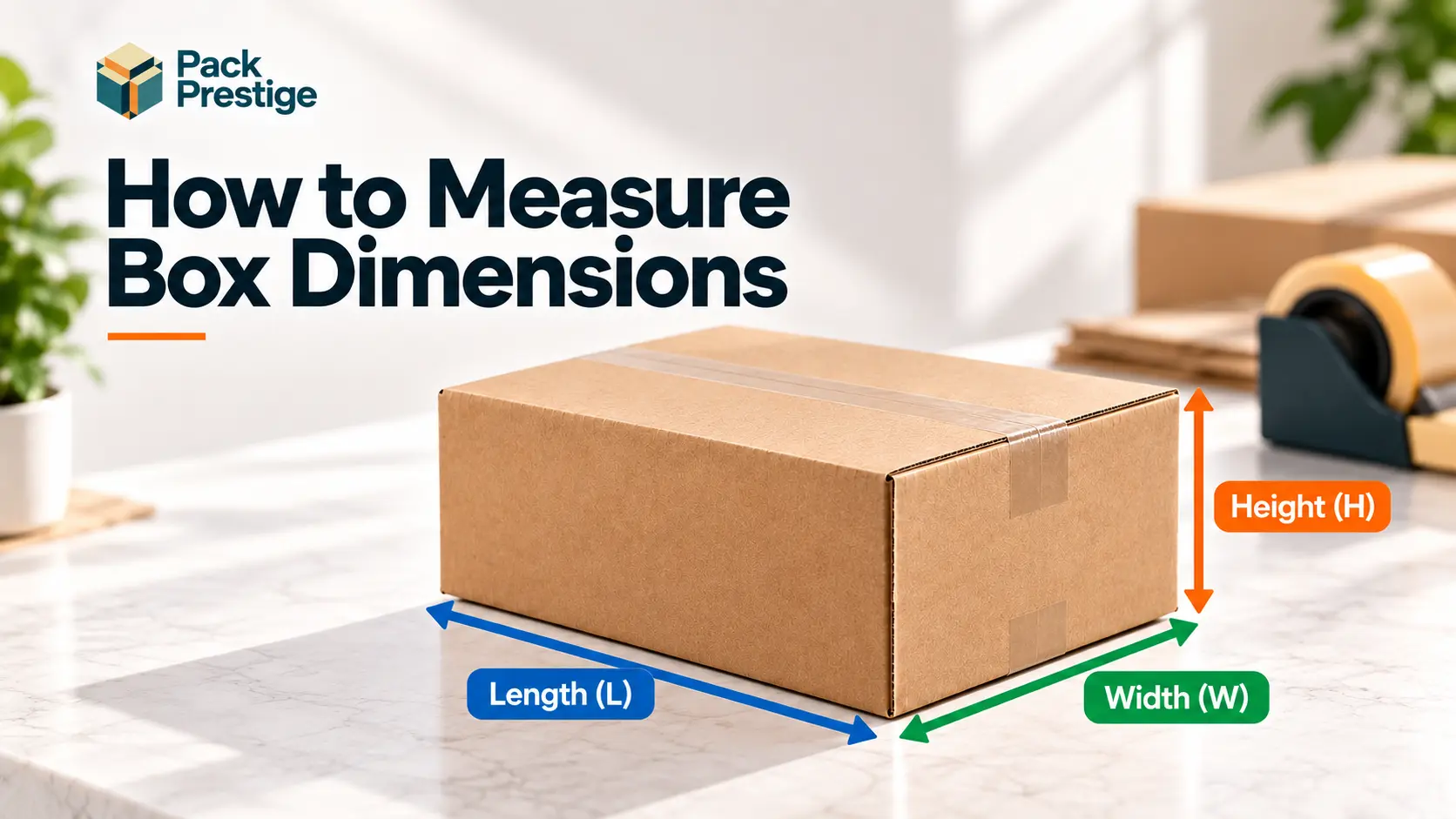
The bigger box costs more due to higher use of board material and fewer boxes fitting on the same press sheet. A 12 x 12 x 12 inch shipper uses far more corrugated than a 9 x 6 x 4 inch mailer. The dimensional weight section below explains the shipping effect.
Print Method and Color Count
Digital printing does not use any plates and is good for short runs. Offset printing uses metallic plates, hence more precise detail. Another consideration is the number of colors; CMYK prints produce full-color artwork using 4 colors, but Pantone spot colors use an additional ink for each color.
Finishes and Add-Ons
The surface is finished with matte and gloss or soft-touch lamination; spot UV adds a glossy highlight; and foil stamping and embossing or debossing press metallic or raised detail onto the box. Hence, a rigid gift box with foil and embossing with an insert is more expensive than a plain tuck-end carton with one coat of lamination.
Setup and Tooling or Plate Charges
Setup charges cover the cutting die and printing plates made for your box and many suppliers bill them as a separate line of $200 to $1,500 per job. The cutting die cuts the box blanks, while the plates transfer your artwork to the press. Flexographic plates cost about $1,000 each.
Since they are one-time charges, they have a big impact on small orders and are practically negligible on large orders. Make sure you ask all suppliers whether setup is included in the unit price or listed separately. Board grade is a determinant of cost since thicker boards have more fiber and process cost. There are no die or plate charges at Pack Prestige.
Turnaround Time and Rush Production
The faster turnaround is going to cost you more since a rush order comes before any of the other scheduled orders on the press and cutting lines and many suppliers have an additional charge for this. Rush production by Pack Prestige will take you 6 to 8 business days.
How Much Do Custom Boxes Cost by Box Type?
The four box types most businesses price out are folding cartons and corrugated mailer boxes or corrugated shipping boxes as well as rigid boxes. The table in the first price section summarizes them and the sections below explain what moves each price.
Folding Carton Cost
A folding carton is priced from $0.40 to $2.50 per unit, making it the cheapest custom box style for retail packaging. A folding carton is a one-piece printed carton shipped flat and folded on the packing line. Heavier board and full-coverage print including windows and inserts push the price toward $2.50. Cosmetics and food or supplement brands order them most.
Corrugated Mailer Box Cost
The cost of corrugated mailer boxes ranges between $0.50 and $5.00 per piece and a 9 x 6 x 4 inch mailer will drop from about $1.40-$2.20 for 250 pieces to $0.45-$0.70 for 10,000 pieces. A mailer box is a one-piece corrugated box that folds without tape and doubles as the shipping carton. Thus, e-commerce and subscription or apparel brands order them most. The price will be determined by flute type and printing. Mostly ordered by e-commerce and subscription as well as clothing companies.
Corrugated Shipping Box Cost
The custom 12 x 12 x 12 inch shipping box goes for $1.45 to $2.20 each at 500 quantities and comes down to $0.60 to $0.95 at 10,000 quantities. It costs $0.90 to $1.40 each at 2,500 pieces. The corrugated shipping box is specifically designed for transporting products through carrier channels. However, printed shippers cost more than plain brown boxes due to the use of plates and ink. Board size and quantity mainly determine the price.
Rigid Box Cost
Rigid boxes are normally priced at $2.50 to $20 per unit or even higher because each box is made up of chipboard material and is covered manually or semi-manually through equipment. There are different prices quoted for such boxes ranging from $1 to $25. Therefore, the typical pricing range is $2.50 to $20.
How Does Order Quantity Change the Price per Box?
The cost of the box will reduce with an increase in your order since the fixed costs are shared among more boxes. Fixed costs are constant at all levels of production, but variable costs keep repeating themselves for every box. The following table indicates the cost of the unit at different order sizes.
| Quantity Tier | Typical Price per Unit (USD) |
| 100-500 units | $2.50-$12.00 |
| 1,000-2,500 units | $1.20-$6.00 |
| 5,000-10,000 units | $0.45-$3.50 |
| 20,000+ units | $0.35-$2.50 |
Small Runs of 100 – 500 Units
Small runs carry the highest price per box often $2.50 to $12 per unit; because setup costs are spread across so few boxes. Even though startups and test launches or limited editions order at this size and digital printing removes plate costs. Pack Prestige has no minimum order, so a run starts at 1 unit and it charges no die or plate fees.
Mid Runs of 1,000 – 2,500 Units
Mid-size runs bring the price per box down to roughly $1.20 to $6.00; which is where many growing brands settle. Proven products and seasonal launches or repeat seller orders at this size. Digital or offset printing fits here; depending on how detailed the artwork is.
Higher Runs of 5,000 Units
Runs of 5,000 boxes or higher enable simple corrugated boxes to cost less than $1 per unit because offset and flexographic presses are quick once the plates have been made. On the contrary, cost ranges are $0.45-$3.50 per unit from 5,000 to 10,000 units and $0.35-$2.50 per unit from 20,000 or more units. Wholesale buyers order here and the trade-off is pallet storage until the boxes are used.
How Much Does Box Printing Cost by Print Method?
Digital printing is the cheapest option for short runs while offset and flexographic printing become cheaper per box once orders reach the thousands. Digital suits short runs, offset suits detailed graphics at mid to high volume and flexo suits large corrugated runs.
| Print Method | Best Run Size | Setup Cost | Per-Unit Effect (USD) |
| Digital | Short runs, from 1 unit | No plates | Adds about $0.20-$0.60 |
| Offset (litho) | Mid- to high-volume | Plate setup varies by supplier. | Litho-laminated retail box: $2.50-$4.50 at 1,000 pcs, $1.15-$1.95 at 10,000 pcs |
| Flexographic | Large corrugated runs | About $1,000 per plate | Varies by supplier |
Digital Printing Cost
Digital printing is a process of printing without plates printing artwork directly from a file and the cost is around $0.20 to $0.60 per box. This method is suitable for short-run printing and testing involving designs that keep changing. The price of each box remains more or less the same even at any quantity. Therefore, digital printing becomes uneconomical for large orders.
Offset Printing Cost
In offset printing the ink is transferred from metal plates onto the sheet and the litho-laminated retail boxes cost around $2.50 to $4.50 each at 1,000 units. The same box costs only $1.15-$1.95 at 10,000 units. Moreover, plate setup is the upfront cost and sharp image quality is the payoff.
Flexographic Printing Cost
Flexographic printing utilizes relief plates made of flexible material on corrugated boards. Each such plate costs about $1000; thus, the process is worthwhile only when used for long print runs. It works well for artwork with a simple design in very few colors. It fits simple artwork with few colors, such as a logo on a shipping carton.
How Much Do Finishes and Add-Ons Add to the Price per Box?
Most finishes add between $0.05 and $1.50 per box with foil stamping and embossing at the top of that range. Each finish adds a separate production step so costs stack when you combine them
Look at these costs per unit below:
| Finish | Added Cost per Unit (USD) |
| Lamination (matte, gloss, soft touch) | $0.05-$0.40 |
| Spot UV | $0.05-$0.60 |
| Foil stamping | $0.10-$1.50 |
| Embossing/debossing | $0.10-$1.20 |
| Windows | Varies by size and material |
| Custom inserts | Varies by size and material |
What Hidden Costs Raise the Total Price of Custom Packaging?
Hidden costs of custom packages are other expenses that are not covered in the cost per package and they are stated below.
- Setup and plate costs ($200-$1,500): One-time cost for dies and plates, included in the setup cost stated above.
- Prepress ($75-$250): Preparation and checking of artwork before printing.
- Freight (add 15-25%): Based on volume of ship; charged according to shipping via box or by pallet.
- Warehousing ($50-$150 per pallet per month after 30 days): Large production that is stored in a warehouse increases the cost as well.
- Sample fees and proof fees: Some of them offer services that incur sample and proof charges.
- Repeat printing due to artwork mistakes: A printing error is an additional cost.
Note: Pack Prestige offers free shipping on qualifying US orders.
Dimensional Weight and Shipping Costs
Dimensional weight is the billing weight calculated based on the box size rather than the scale weight and you will be charged whichever of the two is greater. The formula is length x width x height (in inches) / the carrier’s DIM divisor.
The divisor is 139 for UPS and FedEx and USPS switched from 166 to 139 on July 12, 2027. The USPS uses DIM weight only for packages exceeding 1,728 cubic inches and rounds off each fractional dimension to the nearest whole inch. Make sure to refer to the information provided in the USPS notice and its Federal Register publication.
Examples of calculations: The 16 x 12 x 10 inch box has 1,920 cubic inches; dividing it by 139 results in roughly 13.8 lb, which is rounded to 14 lb. However, if the package weighing 6 lb on the scale is shipped it will be charged at 14 lb. Properly sized boxes can minimize these costs, which relates to the above box size section.
Why Have Packaging Costs Increased in 2027?
The increased cost of packaging was largely due to US mills shutting down 10% of the country’s containerboard capacity, thus giving manufacturers an opportunity for frequent hikes in prices. Four events that occurred during specific times explain this increase in cost.
- Capacity: About 3.9 million tons of US containerboard capacity was closed down permanently between February 2025 and March 2027.
- Price increases: Containerboard rose by about $100 per ton net in the first six months of 2027 (Fastmarkets). The third price increase was announced for September 1, 2027: PCA $140, Smurfit Westrock $100 and International Paper $80 per ton. Increases for SBS and FBB boxboard were also announced, which are important for folding cartons.
- Metals tariffs: As of April 6, 2027, Section 232 levies 50% duty on articles that are wholly or substantially made of steel and aluminum or copper or their derivatives at 25%, based on full customs value. This applies to tins and metal components but not board boxes.
- Shipping: USPS DIM divisor was changed on July 12, 2027.
How Do You Budget and Compare Custom Packaging Costs?
To budget for custom packaging you calculate the cost per unit lower it with six practical decisions and check the answers to the questions buyers ask most.
Formula: Cost per unit = (fixed costs/quantity) + variable cost per unit + (freight/quantity).
These are the steps that convert the price range above into a budgeted number and a line-by-line comparison of quotes.
How Do You Calculate Custom Packaging Cost per Unit?
To calculate your cost per box; divide the fixed costs by your quantity and add the per-unit production cost and your share of the freight.
- Gather every line from each quote: setup and plates including production and finishing or freight.
- Separate the line items into fixed costs (one-time) and variable costs (per box).
- Divide the fixed costs by your order quantity.
- Divide freight by your quantity and add it to the total.
- Compare the per-unit totals across suppliers; not the headline unit price.
How Can You Reduce Custom Packaging Costs Without Compromising on Quality?
Six choices will help reduce your custom packaging costs without reducing the quality of your box and they are right-sizing the box. Matching the print process to the quantity you need and limiting your finishes to one accent along with standardizing the box sizes you use. Approving the 3D box mockup and comparing quotes by landed cost.
Right-Sized Box To The Product
Right-sizing the box cuts cost twice: once in board and again in shipping charges. Additional space is wasteful and could cause the box to fall into the next weight category.
Match the Print Method to the Run Size
Matching your print process to your quantity will keep you from being charged plate fees for a short run or digital printing fees for a long run. Digital works for short quantities and offset/flexo for large quantities.
Limit Finishes to One Focal Point
By keeping the finish to only one focus point, such as a foil logo on the cap, that ensures the unboxing experience while reducing additional processing time. A single-point UV logo is cheaper than foil and embossing or a window.
Standardize Box Sizes Across Products
If you standardize just a few sizes for your boxes, you can purchase more quantities of these. It means lower cost per box. With six products of different six sizes, there could be only three in some cases.
Approve Your 3D Mockup Before Production
If you approve your 3D design before going into production, you will catch all mistakes in sizing and artwork at a stage when they are still free to correct.
Note: Pack Prestige offers free 3D mockups and free design support or free die line templates.
Compare Quotes on Total Landed Cost
In comparing the quotes for total landed cost, one can see the actual cost difference between suppliers when taking into account the costs of setup and plates or shipping. Landed cost is the unit cost plus setup and plates as well as shipping and storage.
FAQS
Is it possible to order custom boxes without the MOQ?
Yes, manufacturers such as Pack Prestige accept custom box orders without a minimum order quantity (MOQ), even for single boxes. This flexibility is beneficial for small brands that often face high minimums with other companies.
Is there a charge for the die and plate included in the unit cost of custom boxes?
No, custom makers normally have separate costs for dies and plates, which are priced from $200 to $1,500 per order. Pack Prestige does not have such costs because they are not included in their quotes.
Would a smaller box reduce shipping costs?
Absolutely, a smaller box can help to reduce shipping costs if dimensional weight is considered instead of actual weight. This is because lighter goods packed in large boxes attract higher dimensional weight costs.
Is digital printing less expensive than offset printing in the case of custom boxes?
Yes, digital printing is cheaper than offset printing for short runs, but offset becomes more cost-effective for over 1000 boxes due to plate costs in offset printing.
Is custom packaging worth the cost for a small business?
Yes, it is worthwhile for any small company to pay for custom-made packaging, since a box made according to measurements will protect the goods and reduce shipping costs.