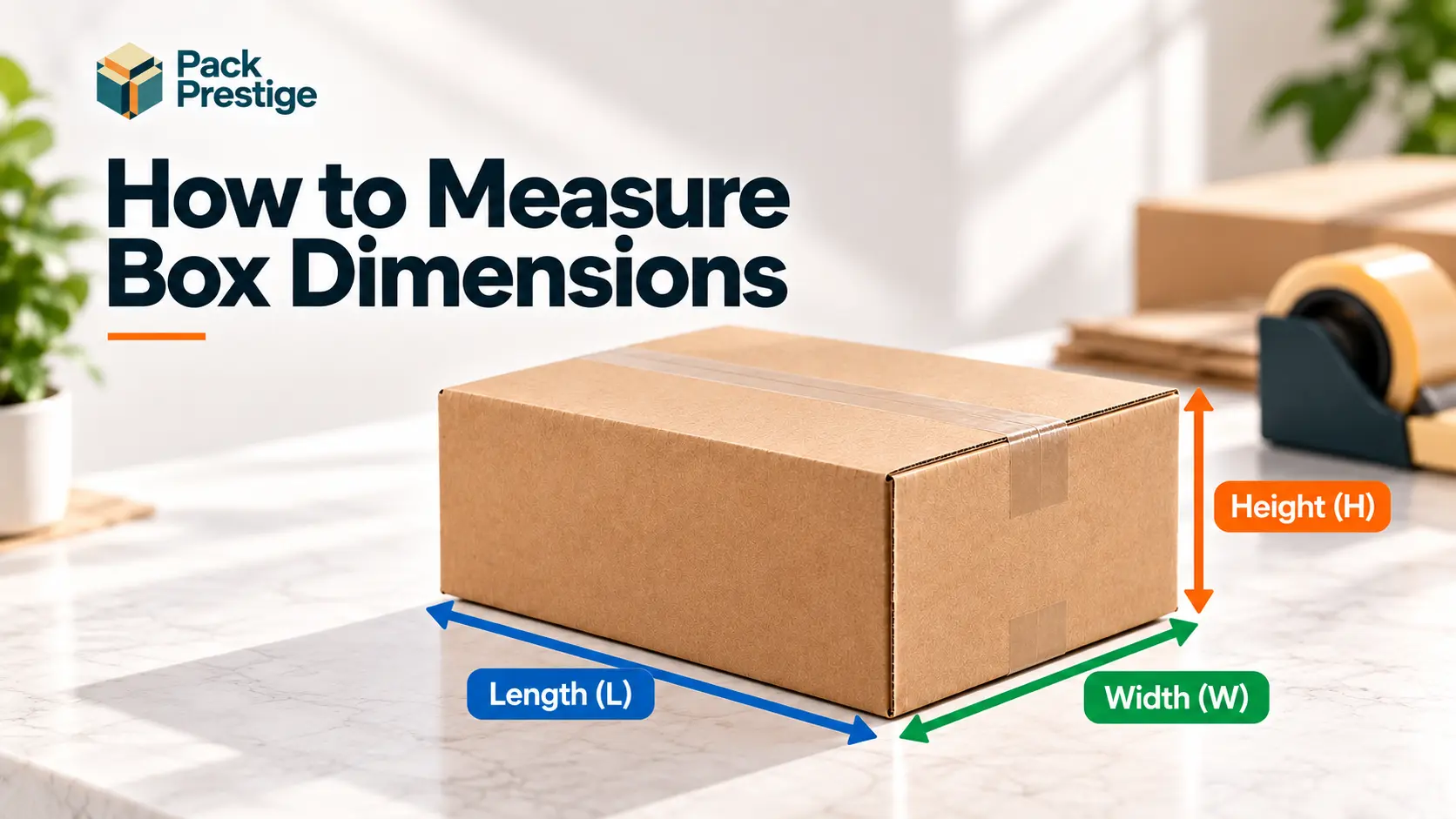
Take the measurements of the box using the length x width x height formula. Whether it is interior or exterior dimensions must be mentioned because interior dimensions determine product suitability and exterior dimensions determine the external size of the box.
Space must be left to allow for inserts and stuffing along with closures and movement of the product inside the box. The interchangeability of length and width determines the design of the box, and taking only exterior dimensions can inflate the actual capacity inside the box.
This guide provides essential tips for measuring box dimensions for custom packaging using the standard format of length x width x height (L x W x H). It highlights the importance of distinguishing between interior and exterior measurements and suggests allowing extra space for inserts and padding to ensure product security.
What Is the Standard Format for Measuring a Box?
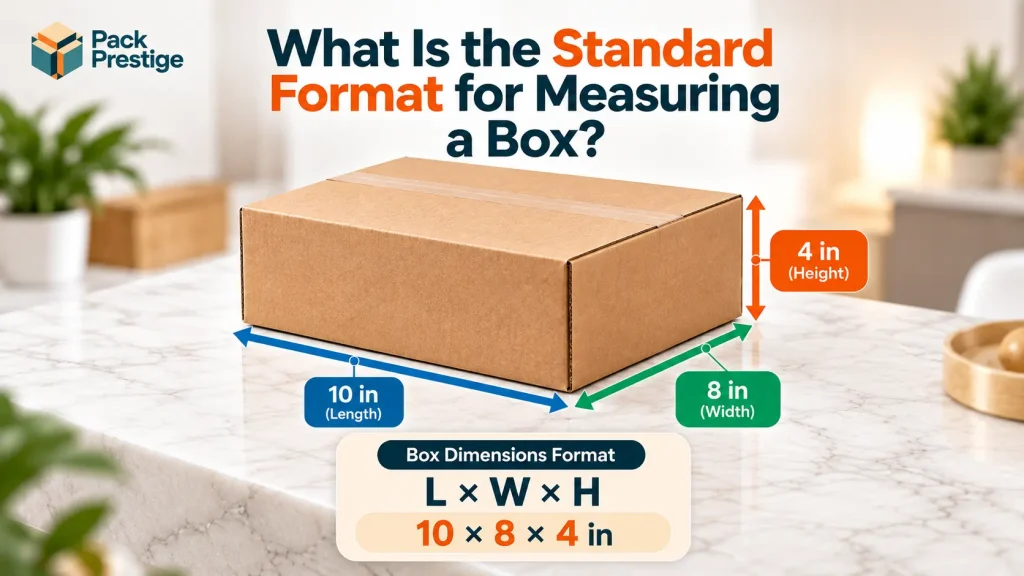
The standard format for measuring box dimensions is length x width x height, represented as L x W x H. For example, a box measuring 10 x 8 x 4 inches has a length of 10 inches, a width of 8 inches and a height of 4 inches.
The unit of measurement (inches, centimeters or millimeters) must be specified for each dimension because without any unit of measurement, “10 x 8 x 4” means nothing to the supplier. The dimensions of length and width are fixed and the box volume will not be affected. However, this may result in a different preference for the box.
How Do You Measure the Length, Width and Height of a Box?
To accurately measure the length, width, and height, it is advisable to use a measuring tape starting from one corner of the box. In that case, the length is measured along the longest horizontal side. The width is measured along the shortest horizontal side, which is perpendicular to the length. The height is measured from the bottom to the top, vertically. All these measurements should be taken from the same corner for consistency among themselves and the manufacturer.

How Do You Measure the Length of a Box?
Length is the largest measurement on the bottom of the box taken from one corner to another. It is always adjusted up because being small is the most common issue in a custom-made box. Length can be slightly less but if it is, the box will not fit the product.
How Do You Measure the Width of a Box?
Width is the shorter horizontal side, measured at a right angle to the length on the same base. The width is also always modified and is based on the same tape measure pull as the length. Both the width and length measurements determine the size of the base on which the product or insert must fit.
How Do You Measure the Height of a Box?
Height is the measurement from base to rim, measured vertically from the bottom to the top of the box. In a lidded box, such as a jewelry box, the height is measured on the base and lid separately, because the two pieces will fit together like a puzzle. Not measuring both pieces will result in overlooking the depth of the lid.
Which Five Tools Are Required for Measuring Boxes?
To accurately measure boxes of various types and it is essential to have the right tools. There are five different tools that are sufficient for measuring all types of boxes from a simple mailer to a presentation box.
- Tape measure or ruler: It helps measure length, width and height along all straight edges.
- Calipers: This helps measure the thickness of the walls and smaller inner dimensions that the tape measure can’t measure.
- Level flat surface: It helps keep the box at 90° angles to measure the length and width.
- Paper to write on: This helps you write down all numbers in the right order of L x W x H before they get jumbled up.
- Scale: A scale measures the weight of the box, which the supplier needs along with the dimensions

What Is the Difference Between Interior and Exterior Box Dimensions?
The interior dimensions of a box represent the usable space within it. On the other hand, the exterior dimensions represent the total area covered by its outer surface. Both measurements are important for suppliers. One determines the fit while the other determines the footprint.
Here you can find the table for noting down the differences:
| Measurement type | Where you measure | What it shows | Used for |
|---|---|---|---|
| Interior dimensions | Between the inside walls of the box | Usable space inside the package | Product fit and inserts like dividers and cushions. |
| Exterior dimensions | From one outside wall to the opposite outside wall | Completed outside footprint | Storage and shelf spacing, along with palletizing and shipping |
| Interior length | Inside the longest base edge | Available length for the product | Placement of product and layout |
| Interior width | Inside the shorter base edge | Available width for the product | Product fit and insert sizes |
| Interior height | From the inside base to the rim or underside of the lid | Available vertical space | Product height and tissue (e.g. insert and closure clearance) |
| Exterior length | Across the longest outside edge | Full box length | Carrier dimensions and warehouse logistics |
| Exterior width | Across the shorter outside edge | Full box width | Storage/stacking and shipping computations |
| Exterior height | From the outside base to the highest point | Full assembled height | Dimensional weight and shelf placement |

Why Does Wall Thickness Change a Box’s Usable Space?
The wall thickness is the distance between the inside and outside measurements of the box and affects the box’s usable interior space. The single-wall corrugated board measures around 3/16 in (4.8 mm), while the rigid chipboard used in rigid set-up boxes measures around 2-3 mm thick. This refers to both opposing walls, meaning that a box with 3 mm walls on each side would lose 6 mm of space just for the walls alone.

How Much Clearance Should You Leave Around a Product?
Product clearance should be 1/4 to 1/2 inches (6mm to 13mm) on all sides, allowing for cushioning while preventing movement of the product. For instance, a delicate product like a glass ornament requires clearance to be padded with foam, not left as empty space. A flexible product like folded clothing requires less clearance due to the ability to move to fill the space.

Clearance Depending on Product
For soft products like folded clothes and scarves or socks, less clearance is needed, as the material is compressible and will fill in spaces. For rigid products like bottles and jars or electronic accessory parts, clearance to avoid making contact with the walls and removing safely.
Clearance Depending on Box
There will be more clearance needed for cushioning with a corrugated shipping box than for a rigid presentation box with an insert. The material of the box, type of closure used, interior support, and shipment method will define the clearance.
Determining Final Box Dimensions
Dimension your product at its longest, widest, and tallest points and then add clearance and the insert or cushioning dimensions. No unused space should be left for any fragile products since unused space means there will be room for the item to move.
What Mistakes Should You Avoid When Measuring a Box?
Five main mistakes cause problems in the fitting of the box to your custom order and it is very helpful for you to know about them.
- Inaccurate clearance: This is where insufficient clearance leaves no place for cushioning, while excessive clearance allows movement of the item during transit.
- Length and width reversed: It rotates the box and results in a misaligned printing design.
- Interior and exterior measurements confused: This results in the wrong dimension being sent to the supplier.
- Incorrect measurement of an irregularly shaped item: It doesn’t include the widest and tallest dimension that requires clearance from the box.
- Underestimating rather than overestimating the measurement: This results in a box that is exactly the wrong size to accommodate the item.
Do Box Dimensions Affect Shipping Costs?
Yes, the dimensions of a box determine its DIM weight, which is used by transportation companies like UPS and FedEx, as well as DHL Express. They quote their rates for delivery of a shipment when the box is big but not heavy enough.
Calculation involves the multiplication of the length, width, and height of the box and dividing the product by the divisor. The divisor is set by the individual carriers on their own rate sheets.
What Are Common Box Dimensions by Product Type?
These sizes work as references and not as standard dimensions, as all products will require their own measurements.
- Jewelry and ring boxes: About 2×2×1.5″ and 3×3×1.5″. This is meant for one item.
- Necklace boxes: Approximately 8×2″ and 10×2.5″ and are meant for a long and flat item.
- Two-part gift boxes: Often 4×4×2″, 6×4×2″, and 8×6×3″. It increases in size depending on the gift being packed.
- Apparel boxes: Approximately 12×9×6″ to 12×10×4″ and larger. This depends on folded clothes.
- Rigid box wall thickness: Ranges from 1.5mm to 3mm and sometimes this reaches 4mm.

How Do You Get Accurate Dimensions for a Custom Box Quote?
A custom box quote requires three parameters: the length, width, and height of the product; the clearance needed around it; and a specification to state if it is an interior or exterior measurement.
This applies to all categories of boxes that we manufacture. This ranges from rigid boxes and gift boxes including jewelry boxes and apparel boxes as well as display boxes, together with pharmaceutical boxes and retail boxes.
Once these three inputs are confirmed. You can request your quote!